Aneta Svetieva’s retrospective exhibition

This year too, the National Gallery continues its mission. We have the distinct pleasure to announce the presentation of Anita Svetieva’s work. The exhibition will officially open on the 21st of May 2025 (Wednesday) at 20.00 hours and it will be displayed until the end of August.
Aneta Svetieva’s constitutes a part of the National Gallery’s program to comprehensively present the Macedonian modern artists who have created our artistic scene. The project follows the monograph for Svetieva issued in 2023, which completes the long years of following and researching of the rich creative opus of one of the most significant Macedonian sculptors.
Aneta Svetieva’s intricate, complex, innovative, and creative work places the fruits of her labor on the very pinnacle not only of the Macedonian scene, but also of a broader platform that transcends the regional boundaries.
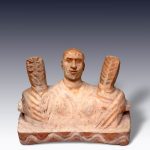
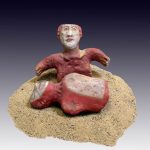
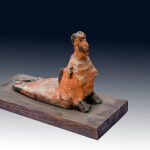
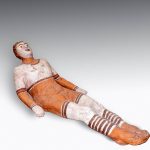
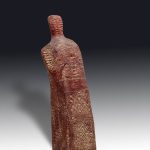
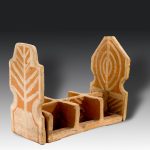
In the early 1970s, the different views not only of the form, the appearance, but also some substantive questions related to the artwork, caused art criticism to define Aneta Svetieva’s sculptures (already during her first presentations) as works of art with a clear conceptual artistic process, beyond the common language models. Those sparkling moments, beyond the general stylish movements and already contoured schemes, created a bespoke breakthrough in the subject matter of sculpture. Her individual plastic expression, imposing with the sheer strength of authenticity out of the main current flows, initiated the inner being of the artwork, its vibe, reacting to the living zeitgeist, as the sign of modernity. The inner diktats are generated from the sources of her interest in ethnos, folklore, and baked soil as primeval artefacts, as accessories to the deeds of the emancipated human spirit. Her artwork engages in a thorough discourse with the ethnological treasury and the customary traditions in the Balkans and abroad, and she uses them as a basis for building her own mythological landscapes and resurrecting collective myths to the level of the universal. In her forms, the materialized idea imposes itself with a persuasive testimonial of the dense, layered entanglement of art in the present moment and the layers that might awaken in any artist. Aneta realizes and emphasizes this juncture, and it also contains the answer to the crucial question about the origin and the layered meaning of her artwork. In the catalogue for the exhibition in Belgrade, 1984, Aneta states: “My thoughts, a kind of fluid … even before, during the first steps, turned towards this world of myth, as nativeness, authenticity, as my identity expressed with syntagms, with sequences from various areas and ways of understanding of the life of my people, my soil and region. Everything is connected in some way.”
The suggestive accents – contours, facial features, erotic and metaphoric indications, ironic notes, cynicism, symbolism and energy, tactile passion, inner tension, sensitivity, curiosity and playfulness, urge to explore and experiment, pleasure of creating … make up the inventory of devices in the interaction between the gaze and the touch, the shape, the color, the nooks and crannies, the energy that wants to burst out. They speak of the deepest human suffering and the elementary life pleasures and joys, of love, but also of violence and of death, the attempt to overcome fear, they open the doors to the other, the unknown, the never-fully-understood. They exude the feeling of a living spirit that mysteriously floats above the forms and shapes, above the lines, the crevices, the tactile traces of the finders that shape reality in their own image. Turning towards these topics and values, that have been present for centuries in the living folktales, the living fantasy of the Macedonian people, she established a magical synthesis between the poetry of the rural and the urban, the past and the present, thereby creating the opulence of her visual narration. Her works of art are not a fragment torn from the world, but rather a closed universe encompassing a life zone, a pure circle that contains within itself everything and anything that might exist beyond it.
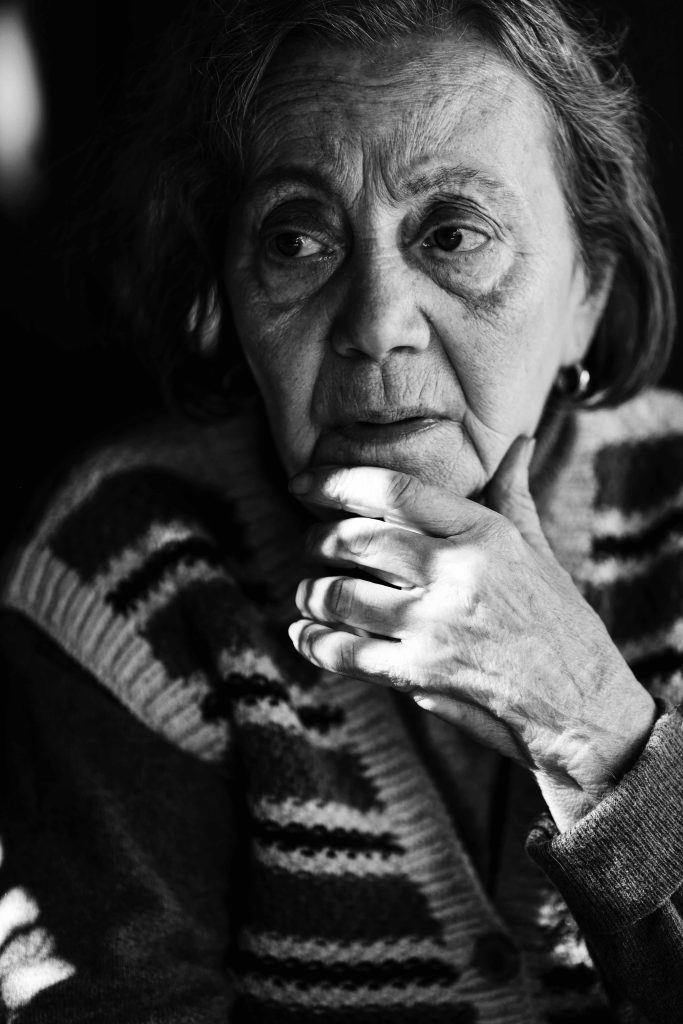
In the prophets, the bathers, the features, the rivers … in Eros and Thanatos, in the Doubles … it is not difficult to recognize the archetypal images of fear, uncertainty, anticipation … that, long since, have stalked man, powerless to understand himself within the world and explain the forces of nature and the universe. These archetypal forms layered in the complex layers of the collective unconscious, release tense, compressed, swollen psychological that breaks through into the conscience whenever the ego is threatened, whenever there is an unresolvable conflict between the human and the environment. All of her works contain their own secret in the conflict between life and death that transcended into a higher symbol of her art. For her, life is not an optimist exaltation, just as death is not a world tragedy, the difference is small, almost insignificant, it is a conflict without a winner … Svetieva’s sculptures are an original mostly a lonely phenomenon. One can safely say that all of her artwork has been created in a today, forgotten category of instinctive, freed need to create which cannot be substantiated with the usual standards applicable to this type of art.
In painting art, human traces in time and space, she showed her great talent: from elementary life situations related to customs, habits, memories … she created a monumental work of art that speaks and forces you to hear the echo of the return towards magical worlds, fundamental values, and a large, complete and comprehensive work of art appears before you as a complete artistic reflection in time.
Biography
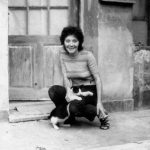
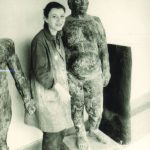
Aneta Svetieva was born in Bitola in 1944. She graduated from the Academy of Fine Arts (1968) in Belgrade and completed her graduate studies in 1971.
In the period from 1965 to 1971, for innovation and specific artistic expression, she received three prestigious student awards, as well as the award of the Association of Fine Artists of Serbia. In 1974 she returned to Macedonia. Since 1977 she worked in the Folklore Institute. In 1988 she completed her doctoral studies in the Ethnology Department of the Faculty of Philosophy in Belgrade. In 1990 she started to work in the Institute of Ethnology at the Faculty of Mathematics and Natural Sciences in Skopje, where, in 1995, she became a full professor. Her participation in significant international art events always attracted special attention of the art criticism, as is also the case with the Venice Art Biennale in 1997, where she was characterized as an author with a peculiar, different approach to shaping an authentic and autochthonous work of art beyond the features of the usual trends.
The project is curated by Viktorija Vaseva Dimeska, art historian, in cooperation with Dr. Ana Frangovska, curator advisor, Maja Nedelkoska Brzanova, curator advisor, and Maja Chankulovska Mihajlovska, senior curator.