Vasil Vasilev, Continuity as a Metaphor 1967 – 2012 / 2012 – 2025
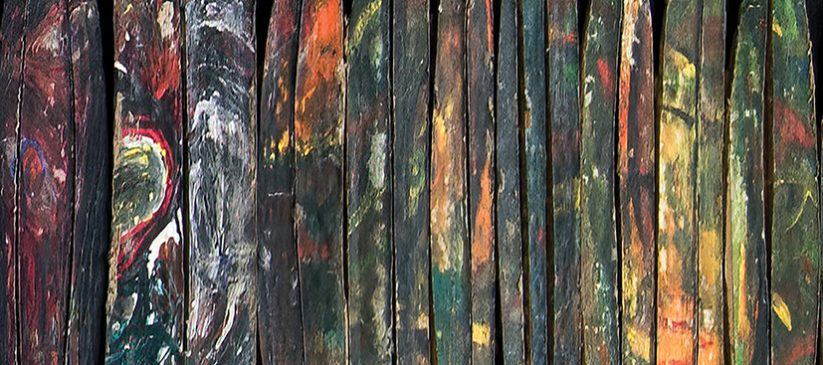
It is with great pleasure that we invite you to the opening of Vasil Vasilev’s exhibition entitled “Continuity as a Metaphor 1967 – 2012 / 2012 – 2025”, on October 17, 2025 (Friday), at 19:00 at the Daut Pasha Hamam Gallery.
Vasil Vasilev’s sculptural oeuvre is a continuum of thorough, persistent and inventive research. Although his development path moved from concrete figurative forms to the reduction of the figure to a sign, the basic parameters did not change, as did the relationship to the object. Regardless of certain stylistic shifts in the manuscript, depending on the matrix of immediate or indirect inspirational experiences, his artistic oeuvre allows to be defined through the variations that took place inside an adopted and over time extended and upgraded artistic syntax.
The Associative Verticals, part of Vasilev’s latest series, are a summary of all the attributes of his formative thinking, translated and conveyed with minimal formal content, concentrating on those crucial totalities of his work: concave and convex, smooth and rough, dark and light surfaces , contents of the growth of their vertical building, alternating, multiplying – to finishing it in a frame. The frame is a way of emphasizing, highlighting, but also calming down the playful, rhythmic shape, structural scheme in the core, that similar procedure that appears in his works from the eighties (Rhythm, 1983), now with a more closed static rhythm and a more simplified form.
Therefore, the artistic structure of the artist’s works from the beginning of the seventies continuously moves to his latest achievements. They contain both the drawing and the relief, the architectural arrangement of volumes that were more emphasized at the time, as well as the pictorial admixtures (mainly in dark tones with a patina of the wood).
The Associative Verticals follow the verticals of the seventies (Caryatids). Unlike the former verticals where the form was often built according to the flat surface-volume principle, now, on the one hand, it simplifies the form, but, on the other, it complicates it with layered architectonics or with playful surfaces in relief.
The combination of sculpture and relief, but also the pictorial treatment of the material with soft tonal transitions and light-dark gradations or sound color play are also defined by the movement of the line. The linear arabesque dates back to the beginnings of his work, it is present in all his works and occurs with variable intensity and role: in some it initiates the formation of the shape, in others it marks, demarcates the forms, sometimes it emphasizes the volume, and other times it initiates the coloristic play of the relief segments. Certainly, it has one of the primary roles in the formation, in the shaping of the work. The sound of the line, drawing elements, which close or open the form, as well as the play of light and dark, captures them with different processing of the material, enriches the sculpture with a lively energy to the point where the suggestive reality is transformed into an associative one, the work becomes a sign with multiple connotations. It reinforces the reduction of the motive to a purer form, leaning, in some situations, to the symmetrical harmony of the composition or, in turn, seeking the order in the discrete rhythms of the volume.
Developing the possibilities of new forms of expression in the context of his relationship to the material and the way of its transposition, in his latest works, Vasilev realizes a special kind of artistic expression that undeniably communicates with his previous creative phases, now based on the denser coexistence of the line, on more emphasized coloristic segments, on the schematic of linear, relief and coloristic rhythmic stylizations.
These intertwined forms, precisely built, layered wooden forms, in their complex variety, in the variable array of associations (from pure geometric to associative floral motifs), bear within themselves the characteristics of a single, meditative and rather irrational mood emitted by his spontaneous plays of the architecturally built associative verticals. The roadmap in the search between the idealized and the essential is aimed at the problematic and enigmatic, which in the last works receives an epilogue of duration, as a flash on the trail of excitement. Expressively strengthened psychological states are manifested in the expression of the inner archetypal power and its spread, in the great wave of decorative geometric consonances.
The main effect is now assumed by the completeness of the array of the vertical with its internal breaks in the alternating arrangement of forms, in the emphasized and unavoidable play of light and shadows. Mainly, by suppressing the curves, he leans towards sharper geometrized surfaces (regular pieces of wood) which he layers vertically or creates carved, hollowed, chiseled separations of the forms in their very relief setting. Such an approach seems to serve the author to free himself from the organic attachment to the volume, from the consolidation of the forms and their voluminous penetration into each other, moving to the micro level of the minute elements in the construction of the composition, which led him to the descriptive pictoriality of the form, directed him towards the solidity of the sculpture, he reduced the forms to some basic elements multiplied and modified through free interpretation. In them he found a source of systemic interpretations of the limitless power of mosaic placement or defining segments of the whole, ranging from indented, drafted organized forms, through subtle arabesque tattoos, collages of smaller mosaic forms to fitting, multiplication of the same or similar shapes and to their wandering, playful arrangement in different directions.
Viktorija Vaseva Dimeska, art historian
VASIL VASILEV
He was born in 1938 in Skopje. He enrolled at the Academy of Fine Arts in Ljubljana (Slovenia) in the class led by Professor Boris Kalin and Professor Drago Trsar. He continued his studies in Belgrade (Serbia) where in 1965, he graduated at the Academy of Fine Arts in the class led by Professor Jovan Kratohvil. He has been a member of the Association of Fine Artists of Macedonia since1966. He has undertaken study trips to Italy, France, Germany, Greece, Brazil, Egypt, China, USA…
The curator of the exhibition is Viktorija Vaseva Dimeska, the organizers are Maja Nedelkoska Brzanova, curatorial advisor and Aleksandra Zinovski Vilic, curator. Within our program schedule, the exhibition will be placed in the next 30 days.